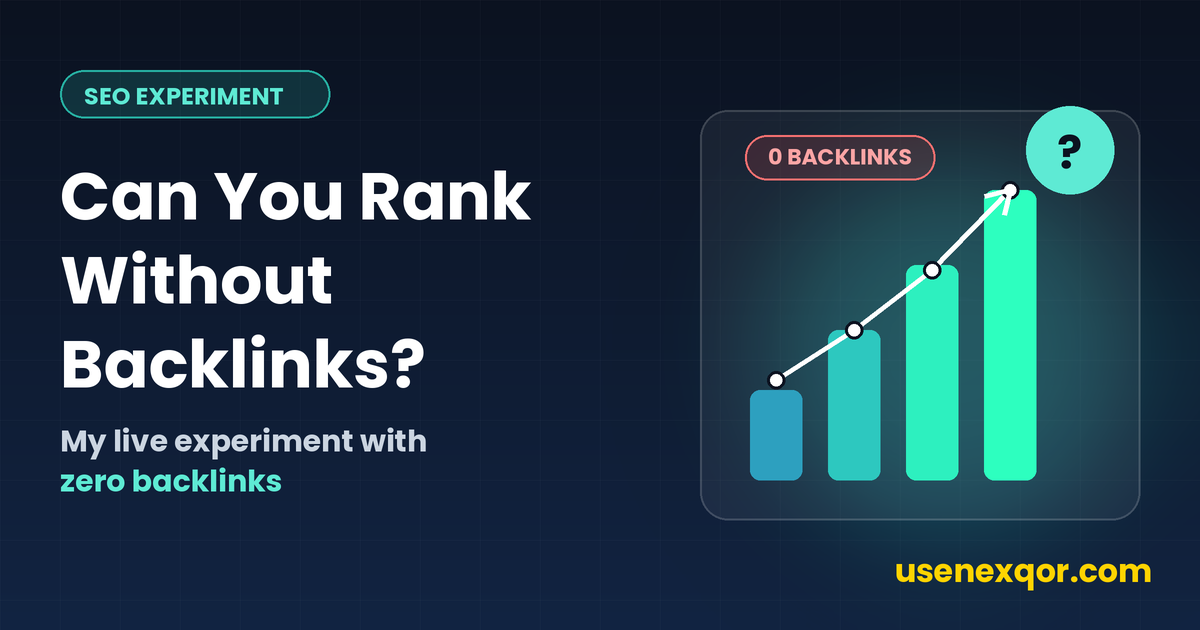
Yes, you can rank without backlinks, but it depends on keyword competition and your site's authority. For low-competition searches, good content can reach page one with zero links. For competitive searches, it almost never happens.
I wanted to see this for myself, so I am running a live test: I am publishing low-competition articles on Usenexqor with zero backlinks and tracking every result in Google Search Console. I will update this article as the results come in.
In this guide, you will learn which keywords you can win without links, which ones you cannot, and how to check a keyword before you write a single word. You will also see a step-by-step plan and when it makes sense to start building links.
The Short Answer: Yes, But Not for Every Keyword
Google has said this openly. John Mueller, a Google Search Advocate, said in a video that you can rank websites without having external links pointing to them (verify the exact wording against the original video before publishing). Links help, but they are not a strict requirement.
The key idea is that ranking is relative. Google does not ask, "Does this page have enough backlinks?" It asks, "Which pages best answer this query?" On a search result page full of weak competitors, a good page without links can win. On a page full of strong brands, it cannot.
Backlinks matter because Google has long treated links from other sites as a sign of trust. However, a page with no links can still win when the pages competing with it are weak or less helpful.
That is why the same article can rank for one keyword and fail on another. Here is a quick summary:
|
Keyword type |
Possible without backlinks? |
Example |
|---|---|---|
|
Long-tail question |
Usually yes |
"how to rank a new blog post in two weeks" |
|
Low-competition keyword |
Yes |
A niche term where forums and small blogs rank |
|
Local search |
Often yes |
"dentist in [small town]" |
|
Medium-competition informational |
Sometimes |
"what is a good bounce rate" |
|
High-competition commercial |
Rarely |
"best credit card" |
|
Finance, health, legal |
Very rarely |
"how to get a personal loan" |
My Experiment: What I Am Testing and What Has Happened So Far
This experiment is still running. I will update this section with real Search Console data as results come in. Last updated: [Insert date].
The setup
- Site age: Almost 6 Month old
- Niche: SEO
- Articles in the test: 10
- Backlinks built: 0 (no guest posts, no directory links, no outreach)
- Test period: 06-05-2026 to 12-12-2026
Results so far
|
Keyword |
Keyword difficulty |
Current position |
Days since published |
|---|---|---|---|
|
how many backlinks per day is safe |
15 |
50 |
2 |
|
what is the best service to merge text into a single document with fewer line breaks? |
5 |
40 |
4 |
|
free backlink checker with pagerank |
20 |
40 |
1 |
|
seo instant appear highsoftware99.com |
10 |
16 |
2 |
What I am tracking, and what I will report
For each article, I am checking whether Google indexes it, how many impressions it earns in the first weeks, and which position it reaches over about three months. I will publish the full results here, including the articles that did not rank, and explain what the winners had in common. [Insert early findings here once available.]
When You Can Rank Without Backlinks
Backlink-free ranking is realistic in these situations.
- Long-tail and question keywords. Specific, multi-word searches have fewer competitors and clearer intent. These are the easiest wins for a new site.
- Low-competition keywords. As a rough guide, a keyword difficulty under 10 to 15 in most SEO tools is a good sign. Treat this as a guide, since every tool scores difficulty differently.
- Local searches. Local SEO often depends more on relevance, proximity, and business details than on a big link profile.
- Results where weak sites already rank. If forums, thin pages, or low-authority blogs sit in the top 10, a better page has a real chance.
- Topics where you offer fresh data or first-hand experience. Original research and unique content give Google a reason to show your page, even without links.
Can you rank on Google without backlinks in a small niche?
Often, yes. Smaller niches have fewer authority sites competing, so a well-made page can stand out on content quality alone.
What about local searches?
For local queries, links are often not the main factor. A complete Google Business Profile, the same name, address, and phone number across your site and listings, and genuine customer reviews usually matter more.
When You Cannot Rank Without Backlinks
Some searches are simply out of reach until your site has earned trust.
- High-competition commercial keywords. Many strong pages already compete, and most have years of earned links.
- Finance, health, and legal niches. Google is careful with topics that affect people's money and wellbeing, so trust signals matter a lot here.
- Result pages dominated by big brands. If the top 10 is full of well-known sites, a new page rarely breaks in.
Take "best credit card" as an example. The results are packed with large finance publishers and comparison sites with strong domain authority and thousands of referring links. A new site with great writing but no links will not outrank them, because the competition has far more proof of trust.
How to Rank Without Backlinks (Step by Step)
1. Pick low-competition, long-tail keywords
Start where competition is thin. Good keyword research is the foundation of this whole approach, and long-tail keywords give you the best odds. If you want to go deeper on finding them, the guides on the usenexqor.com blog cover keyword research in detail.
2. Match search intent exactly
Look at what Google already shows. If the top results are step-by-step guides, write a step-by-step guide. If they are comparison pages, a long essay will not rank.
3. Add original value
Share data, examples, and screenshots that readers cannot find elsewhere. High-quality, unique content is the strongest substitute for links.
After publishing, share the page where your readers already spend time, such as forums, YouTube, or social platforms. Shares are not a ranking factor, but they can bring visitors and help people discover your work.
4. Do strong on-page SEO
Use a clear title tag, a logical set of header tags, and a clean structure. Write a meta description that earns the click. Aim to answer the question fully rather than hitting a word count.
5. Build topical authority with a cluster of related articles
Publish several connected articles around one subject. When your site covers a topic from many angles, Google can better understand what you are an authority on. Publishing regularly helps, but a cluster of useful pages matters more than a high posting rate. Real topical authority usually takes many connected articles, not just a few.
6. Use internal linking between your own pages
Link related pages with descriptive anchor text. This helps readers and helps Google crawl and understand your site.
For example, write one strong guide on your main topic and link to it from every supporting article. This gives the guide more context, and each supporting article points readers to the next step.
7. Keep the site fast, mobile-friendly, and technically clean
Page speed, mobile optimization, and clean crawling all affect how well your pages can perform. A regular site audit catches problems like broken pages and indexing issues early, and a free tool such as the site audit options in our free SEO tools is a simple place to start.
8. Show E-E-A-T
Add an author bio, explain your real experience, and keep your facts accurate. Clear trust signals help readers and search engines believe your content.
How to Check If a Keyword Is Rankable Without Backlinks
Before you write, spend ten minutes checking the search results.
- Search the keyword in an incognito window so your history does not change the results.
- Check the domain authority of the top 10 results. Domain authority is a third-party score, not a Google metric, but it is useful for comparing sites.
- Look for weak pages in the top 10, such as forum threads, thin articles, or very new sites.
- Check how many backlinks those pages have. If several top pages have few or none, the door is open.
- Score the keyword.
You can speed up steps two to four with the keyword difficulty and top-10 analysis tools on our site.
Use this simple traffic light system:
|
Signal |
What you see in the top 10 |
Decision |
|---|---|---|
|
Green |
Several weak pages, few backlinks, low difficulty |
Go |
|
Yellow |
A mix of weak and strong pages |
Maybe, test with a strong article |
|
Red |
Mostly high-authority brands with many links |
Skip for now |
Do Backlinks Still Matter in 2026?
Yes. Backlinks are still a strong ranking factor, and ignoring them forever is a mistake.
Links help in three ways. They speed up how fast new pages gain traction, they make rankings more stable, and they are often the deciding factor on competitive keywords. A backlink analysis of any top-ranking page in a tough niche will usually show why.
My honest advice is to start without links, win the easy keywords, and then add links as your site grows. Starting this way lets you build a base of content and traffic first.
Easy Ways to Get Your First Backlinks (Optional)
When you are ready, these are practical starting points. If you are unsure about pace, our guide on how many backlinks per day is safe for SEO explains why the method matters more than the daily number. Focus on white hat SEO methods only.
- Guest posts. Write useful articles for relevant sites in your niche, using sensible outreach strategies rather than mass emails.
- Digital PR and expert-quote requests. Respond to journalist and blogger requests where your experience fits.
- Resource page outreach. Suggest your content to pages that already list helpful resources on your topic.
- Sharing original data. When you publish research others want to cite, links can come to you naturally.
Common Mistakes to Avoid
- Targeting keywords that are too competitive. This is the most common reason new sites stall.
- Publishing thin or copied content. Duplicate content gives Google no reason to prefer your page.
- Ignoring search intent. A great article on the wrong format will not rank.
- Giving up too early. Google needs time to index and test a page, and results often take around two to three months to appear.
Conclusion
So, can you rank without backlinks? Yes, for the right keywords. Low-competition, long-tail topics with weak results are very winnable, while competitive commercial searches and sensitive niches usually need links.
My experiment is still running, so I will share the full results here once the data is in. Start with keywords you can realistically win, write content that matches intent, and add backlinks once your site has momentum.
Have you tried ranking without backlinks? Share your own results in the comments. I would like to compare notes.
FAQ
Can a new website rank without backlinks?
Yes. A new website can rank for low-competition and long-tail keywords without backlinks if the content matches search intent and is clearly useful. Highly competitive keywords are much harder.
How long does it take to rank without backlinks?
It varies, but a common range is two to three months for Google to index, test, and settle a page. Low-competition keywords may move faster, and tougher ones take longer or may never rank.
Can you rank on page 1 with zero backlinks?
Yes, it is possible, especially for long-tail, local, and low-competition searches where the top results are weak. It is much less likely when the results are full of large brands.
Are internal links the same as backlinks?
No. Internal links connect pages on your own website, while backlinks are links from other websites to yours. Internal links help with crawling and context, but they do not carry the same outside trust as backlinks.
How many backlinks do I need to rank?
There is no fixed number. The right amount depends on the competition for that keyword. Check the backlinks of the pages already ranking in the top 10, and use them as your benchmark.
Do you need backlinks for local SEO?
Not always. Local rankings depend heavily on a complete Google Business Profile, consistent business details, and genuine reviews. Links can still help in competitive cities.
Can a low-authority site outrank a high-authority site?
Yes, on specific searches. A smaller site can win when its page matches search intent better or offers more original value. Domain authority is a third-party score, not a Google ranking factor.