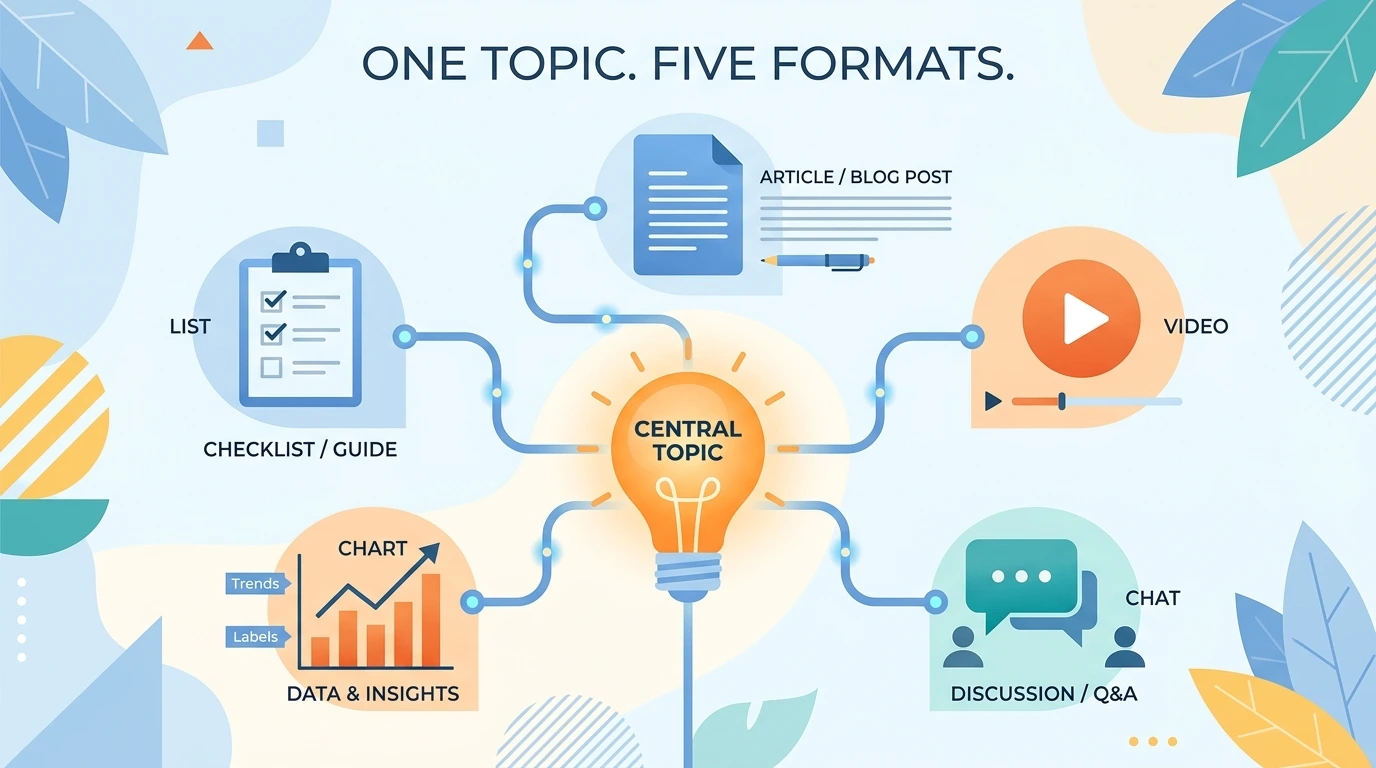
Most advice on this topic is the same: choose a topic, cover it from a few different sides, publish everything, and link the pages together. While this is true, it doesn't help much on its own it's like saying "eat healthy and exercise." People don't fail because they don't get the idea. They fail because they struggle to actually do it: they pick topics that repeat the same information, they try to make five different posts when they barely have time for one, and they never check if their work is actually helping them get traffic.
This is the practical guide for actually doing the work. No made-up examples about climate change, and no fake stories about software companies that you can't verify. It only focuses on what real problems happen when people try this strategy, and how you can fix them.
What “your topics, multiple stories” really means
It means focusing on one main topic and writing several different articles about it. Each article should answer a completely different question, instead of saying the exact same thing five times using different words.
Take "email marketing" as an example. A lazy effort results in five different posts that all explain the same basic definition of email marketing, just with slightly different starting lines. A proper effort, however, looks like this:
● This article explains how a company doubled the percentage of people opening their emails after they stopped dividing their audience by age or location. It shares a real-life result and experience, written specifically for people who are already running email campaigns.
● Email marketing for a 2-person team: This topic focuses on which tasks you should automate first when you are extremely busy and need practical solutions right away, rather than long theoretical explanations.
● The subject line tests that actually moved the needle (and the ones that didn't) — data-driven, for people who've already read the basics elsewhere.
Same topic. This approach targets three completely different readers at different stages of their work, giving each of them a unique reason to click and read. That is the real difference between creating truly different articles and just copying the same article over and over with new titles
The part nobody explains: how to stop your own pieces from competing with each other
This is where things actually go wrong. It is a technical search engine problem (SEO) that most content guides ignore. The writers of those guides don't talk about it because they aren't the ones who have to fix messy search rankings or fix overlapping pages in Google Search Console six months down the road.
Here is what happens when you don't have a plan: you write and publish three articles with almost identical titles—like "Email Marketing Guide," "Email Marketing Tips," and "How to Do Email Marketing Well." Because they cover the exact same thing, Google gets confused about which page it should show first. Instead of ranking one page high, Google divides your website's strength across all three pages, causing none of them to rank as well as a single, detailed page would have.
The fix is intent mapping, done before you write anything:
● Pull every keyword variation your topic touches. Use your Google Search Console data if you already have written content on this topic, or use a keyword tool if you are starting from scratch. Group your keywords by what the user actually wants (search intent), rather than just matching similar words. For example, "email marketing statistics" and "email marketing for beginners" might look similar, but the people searching for them want totally different things.
● Assign one primary keyword per piece. Target an actual keyword that someone would type into Google, not just a broad topic. If two articles on your list answer the exact same search query, combine them into one page instead of keeping them separate.
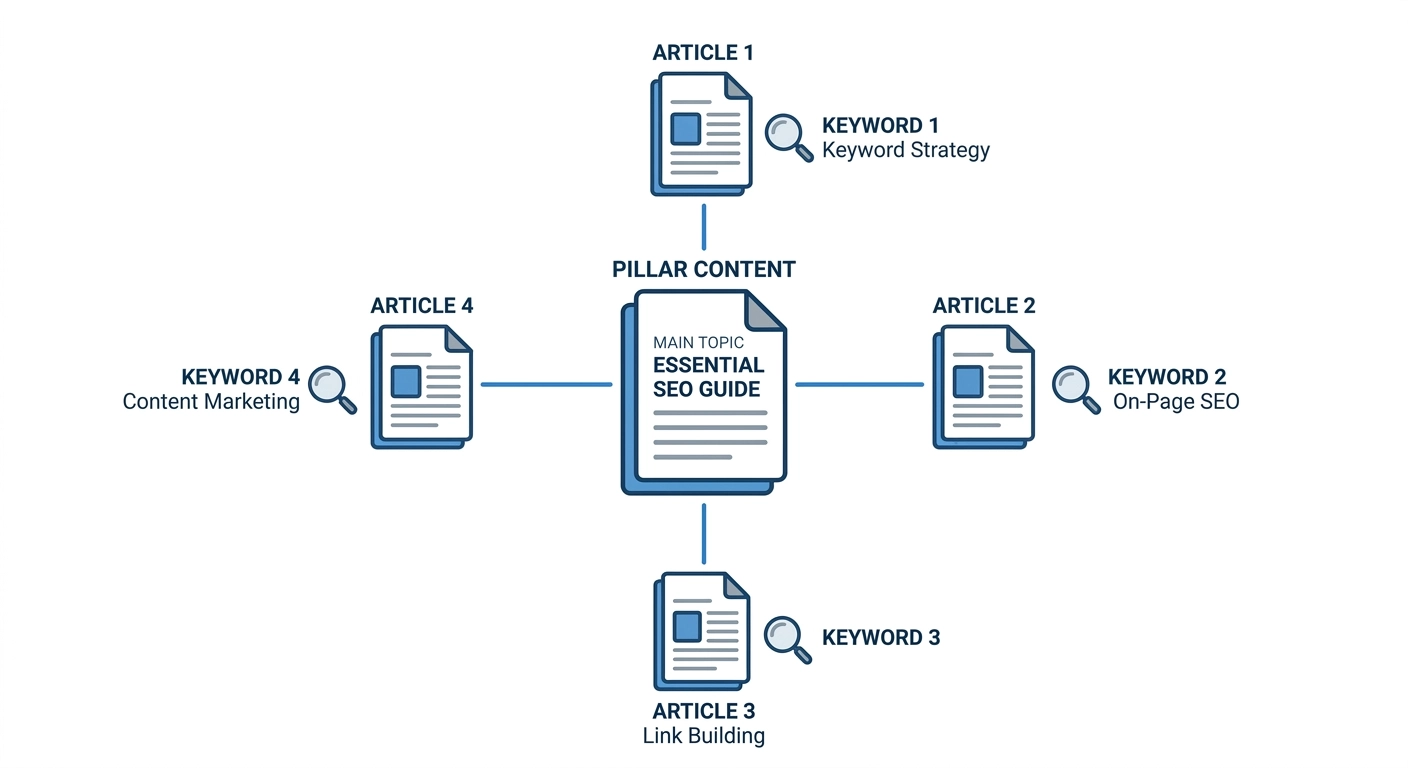
● Pick one pillar. This is the main article that targets the big, high-search keyword. All other smaller articles in this group link back up to this main page, and the main page links down to each of them. This interlinking isn't just for design, it is what tells Google which page is the main source of authority and which pages are just supporting it.
● Check for overlap after drafting, not before. Titles might look totally different when you write them in your planning calendar, but the actual content can still end up saying the exact same thing once written. Read your draft articles next to each other before publishing them, rather than waiting to fix it after you notice your traffic isn't growing.
Skipping this one step is the main reason why most multi-article plans fail. Instead of building one strong topic that ranks for many different searches, people end up with five weak pages that don't rank at all.
Where the angles actually come from
Telling people to "think of 3 to 5 different ideas" is common advice, but no one actually explains how to do it. You don't need to be super creative for this — you just need to search and see what questions real people are already asking online.
● People Also Ask Boxes: Search your main topic on Google and save every question that appears in the "People Also Ask" section. Google is directly showing you what people want to read next.
● Reddit and Online Forums: Search [your topic] reddit on Google. The comments will show you the exact words, problems, and frustrations real people have. These discussions are often much more specific and realistic than what standard keyword tools suggest.
● Your Google Search Console Data: If you already have published articles, check which search queries bring up your pages in search results without ranking near the top. Google is telling you what people are searching for, but your content isn't directly addressing those exact questions yet.
Customer Support Tickets & Client Questions: If you run a business or work with clients, use the real questions people ask before buying. This is an overlooked resource, but these questions are better than keyword tools because they come from real buyers with a clear intent to purchase.
If you run your main topic through two or three of these sources, you will easily find more than enough ideas. The real challenge is not coming up with ideas, it is choosing three to five that don't repeat the same information or compete with each other on Google.
The resourcing problem nobody addresses
Almost every article about this assumes you have a full team ready to create blog posts, videos, podcasts, and infographics whenever you want. Most readers simply don't have that kind of support. If you are working alone, running a tiny two-person agency, or managing several clients as a freelancer, that kind of advice is completely useless to you.
Here's the realistic version:
-
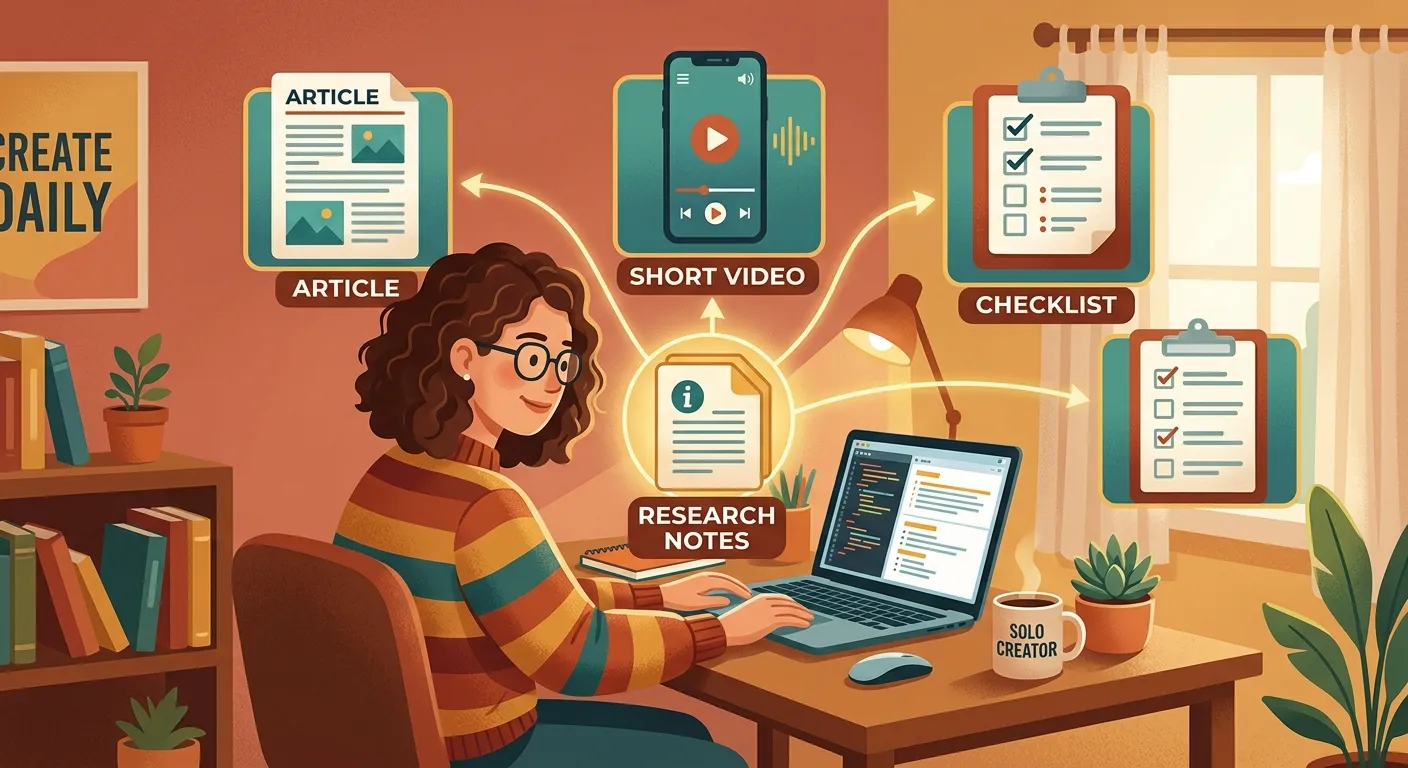
Do research in batches, not writing: Do one single deep research session, client interview, or data search for the whole topic, instead of doing it for every individual article. For instance, a single 30-minute chat with a client can give you enough ideas for three different posts: a founder's story, a product setup guide, and a post addressing customer doubts. You do research once, then use it in three different ways.
-
Choose formats you can actually stick with: If making videos isn't practical right now, don't force it just because a guide says you need videos. Writing two distinct, high-quality blog posts is much better than starting a video project you never finish. You can always add videos or podcasts later after your written posts start performing well.
-
Publish steadily over time, don't rush: Do not publish all five articles in a single week. Rushing doesn't help you, and it doesn't help Google understand your site any faster. Publish your main (pillar) article first, give it time, and then publish supporting articles over the next few weeks. This approach lets you adjust your strategy — if your first supporting article doesn't perform well, you can tweak the next one before wasting effort on the rest.
Why this matters more right now than it did two years ago
Having deep, detailed content isn't just about getting higher search rankings on Google anymore, it is now what determines whether AI tools like ChatGPT or Perplexity will mention and quote your site as a source. When someone asks an AI tool a question, it searches the web and uses sources that directly answer that specific detail, rather than citing a general page that only covers the topic briefly.
If your website has only one broad article on a topic, AI tools have only one chance to use you as a source. However, if you have five focused articles that each answer a specific question clearly, AI tools get five chances to quote you. More importantly, this gives them specific details they can accurately quote or summarize. Thin, general content never gets cited because there are no clear, detailed facts to extract. This gives you a powerful new reason to create organized content groups (topic clusters) beyond traditional Google rankings, and it is a great point to bring up when convincing a client who wants a better reason than just "Google likes it."
A worked example
Take "guest posting for SEO" as an example topic — this is the exact kind of topic cluster we build for clients at UseNexQor when setting up guest post and content campaigns for niche websites. Instead of writing just one general "guide to guest posting," here is how a well-planned content group looks when every article targets a different user intent without repeating information:
|
Piece |
Primary keyword |
Who it's for |
Angle |
|
Pillar: Guest Posting for SEO: The Complete Framework |
guest posting seo |
Someone researching the strategy for the first time |
Broad overview, links to everything below |
|
How to Vet a Site Before You Guest Post On It |
guest post site quality checklist |
Someone who's been burned by low-quality placements |
Practical, checklist-driven |
|
Guest Posting vs. Niche Edits: Which Actually Moves Rankings |
guest posting vs niche edits |
Someone comparing tactics before spending budget |
Comparison, data-leaning |
|
What a Bad Guest Post Placement Actually Costs You |
guest post penalty risk |
Someone worried about Google penalties |
Risk/consequence-focused |
Four pieces, four distinct searcher intents, zero overlap, one clear pillar to anchor them. That's the structure the theory articles describe — but none of them show you the actual table.
Where to start
Pick a single topic you understand deeply, one you can easily write five different articles about without repeating the same ideas. Look up the "People Also Ask" questions on Google for that topic, then group those questions by what the searcher actually wants, not just by similar-sounding words. Select one main, detailed topic to serve as your central pillar page. Write and publish that main article first before creating anything else.
Do not attempt to launch all five articles at the same time. This strategy only works if every article offers completely distinct information. You will write much higher-quality, specific content by completing one piece at a time rather than rushing to meet five separate deadlines in a single week.