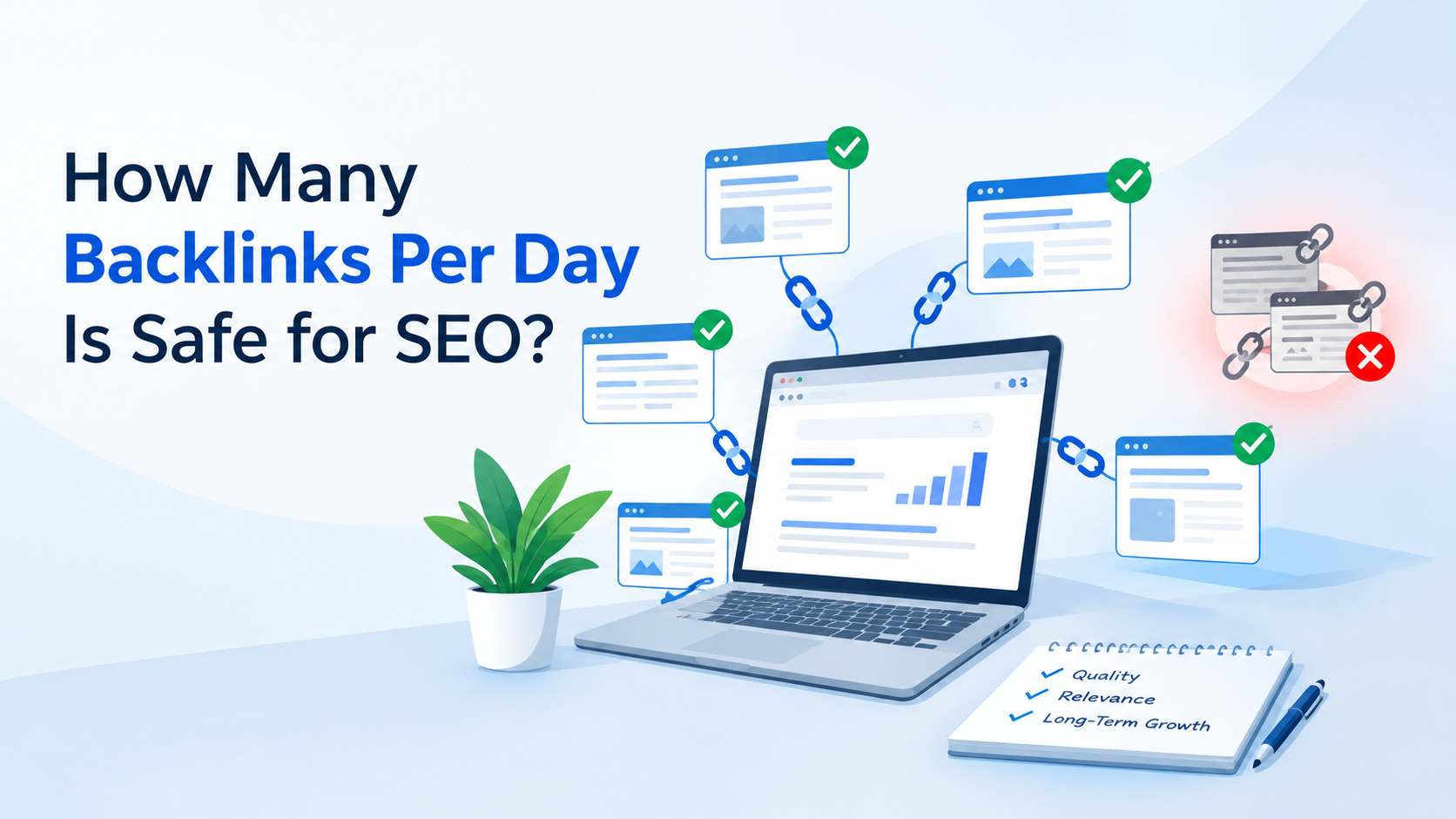
There is no fixed number of backlinks per day that is safe for every website. Some websites earn several new links in one day, while others may go weeks without gaining any. Both situations can be natural.
What matters most is how those links are acquired. Links earned through useful content, genuine recommendations, and relevant editorial mentions can help people find your website and may support SEO. However, creating or buying links mainly to manipulate search rankings can violate Google's spam policies.
Instead of following a daily backlink target, focus on earning relevant links from websites that make sense for your audience. This guide explains how to build backlinks responsibly, what practices to avoid, and how to measure the results of your efforts.
Is There a Safe Number of Backlinks Per Day?
Google does not publish a universal daily backlink limit. There is no official rule stating that building 5, 10, 20, or 100 backlinks in one day will automatically result in a penalty.
The number of links a website earns can change for many reasons. A new product launch, a useful industry report, a popular article, or a mention from a major publication can attract many links in a short time.
For example, imagine that your company publishes an original study about electronic components. Several engineering websites may reference the study within a few days. This increase can result from genuine interest in your research.
Now consider a different situation. A website owner pays for hundreds of links from unrelated websites, uses automated link-building services, and selects keyword-rich anchor text to influence rankings. This activity may violate Google's link-spam policies.
Both situations involve an increase in backlinks, but the methods are very different.
The key takeaway: Do not judge your link-building strategy by a daily number alone. Consider the source of the links, their purpose, their relevance, and whether the methods comply with Google's policies.
For more details, read Google's official spam policies.
What Makes a Backlink Valuable?
A backlink is a link from one website to another. It can help readers discover useful information and help search engines understand how pages are connected.
However, not every backlink provides the same value. A useful link should make sense in the context where it appears.
1. Relevance to Your Website
Relevant links come from pages that have a meaningful connection to your topic, industry, or audience.
For example, an electronics manufacturer may benefit from being mentioned in an engineering article about sensors, circuit boards, or microcontrollers. A link from an unrelated website may be less useful to that audience.
Relevance does not mean every backlink must come from a website in the exact same niche. A general technology publication may still provide a useful reference when its article discusses a topic related to your business.
2. Editorial Value
An editorial link is included because the publisher considers the linked resource useful to readers.
For example, an engineering writer may link to your original MOSFET guide because it explains a circuit design clearly. This link gives readers a reason to visit your page.
Focus on creating resources that publishers have a genuine reason to reference. Do not assume that every link from a high-authority website will improve rankings.
3. The Quality of the Referring Page
The referring page matters, not just the website's overall reputation or SEO metrics.
Look at the page's subject, its usefulness, its intended audience, and whether the link fits naturally into the content.
Third-party metrics such as Domain Rating (DR) and Domain Authority (DA) can help with initial research. However, these are metrics created by SEO tools, not official Google ranking scores. A high score does not guarantee that a backlink is useful or compliant with Google's policies.
4. The Purpose of the Link
Ask why the publisher included the link.
Does it help readers understand a topic, check a fact, or find a relevant resource? Or was it added mainly because someone paid for ranking credit?
The purpose and method of acquiring a link matter more than simply counting it.
What Factors Affect Your Backlink Growth?
There is no universal growth pattern that every website should follow. Several factors can influence how many links a website earns naturally.
Website Content and Audience
A website with useful research, detailed guides, original images, or practical tools may attract links when people find those resources helpful.
For example, a website offering free electronics calculators may earn references from educational websites, engineers, and technical bloggers.
A website with little original information may have fewer natural reasons for others to link to it. Improving the content can be more useful than setting an arbitrary backlink target.
Industry and Competition
Some industries have more publishers, communities, and research resources than others. This can affect the number of natural linking opportunities available.
Competitive keywords may require stronger content, a better reputation, and more relevant references to compete effectively. However, this does not mean a website must acquire a specific number of backlinks every day.
Review competing pages to understand what makes them useful and where your content can offer something better. Do not copy competitors' backlink numbers as a target.
Publicity and Business Activity
Product launches, research reports, partnerships, news coverage, and useful resources can all affect backlink growth.
A company mentioned by several publications during a product launch may earn more links than usual. This increase does not automatically indicate a problem.
Look at the events behind unusual growth before deciding whether any action is necessary.
Existing Content and Reputation
Established websites may have more resources that people already know and reference. New websites may need time to develop useful content and relationships with relevant publishers.
However, an older domain is not automatically protected from link spam, and a new domain is not automatically at risk because it gains several links quickly.
How to Build Backlinks in a Safe and Sustainable Way
The following methods focus on useful content, genuine outreach, and responsible promotion.
1. Create Content Worth Referencing
Publish information that solves a real problem for your audience.
Useful resources can include:
Detailed guides that explain a difficult topic.
Original research with clear methods and findings.
Practical calculators, templates, and checklists.
Technical diagrams or illustrations that explain a process.
Case studies based on real work and measurable results.
For example, an electronics website could publish a guide explaining how to select a MOSFET for a switching circuit. If the guide includes accurate calculations, clear diagrams, and reliable references, other technical writers may find it useful.
The goal is not to create content solely to attract links. It is to provide information that genuinely helps readers and gives relevant publishers a reason to reference it.
2. Use Guest Posting Responsibly
Guest posting can introduce your expertise to a new audience. It works best when the article is relevant to the publisher's readers and meets the website's editorial standards.
Before approaching a publisher, check whether the website covers your topic, publishes useful original content, and has a real audience.
Avoid mass-producing nearly identical guest posts for unrelated websites or placing keyword-rich links in articles primarily to influence rankings.
There is also an important distinction between editorial guest contributions and paid link placements.
Google identifies buying or selling links intended to pass ranking credit as a link-spam practice. Paid placements should be qualified with rel="sponsored"; rel="nofollow" is also an acceptable option for these links.
A paid article can still serve a legitimate advertising or promotional purpose. However, payment should not be used to disguise a ranking-manipulation scheme.
Read Google's guidance on qualifying outbound links.
3. Contact Relevant Website Owners
Outreach can help you introduce useful resources to people who may want to reference them.
Keep your messages personal and specific. Explain why the resource is relevant to the recipient's audience instead of sending the same generic email to hundreds of unrelated websites.
For example, if an engineering blog has published an article about sensor selection, you might share a new comparison guide that adds useful information on the same topic.
Do not pressure publishers to include ranking-focused links or treat every outreach email as a demand for a backlink.
4. Find Unlinked Brand Mentions
Sometimes a website mentions your company, product, or research without linking to it.
You can contact the publisher and ask whether a link would help readers find the original source. The publisher can decide whether adding a link is appropriate.
This approach is most useful when the mention refers to a specific resource or provides information that readers may want to explore further.
5. Build Relationships in Your Industry
Participate in relevant professional communities, contribute useful answers, and share knowledge with people in your field.
For example, an electronics business might collaborate with engineers, educators, manufacturers, and technology publishers.
Do not add promotional links to every discussion. Contribute when you can answer a question or provide a useful resource, and follow each platform's rules.
Link-Building Practices to Avoid
Some link-building methods can create risks regardless of how many links they produce.
Buying Links to Manipulate Rankings
Paying for links specifically to pass ranking credit can violate Google's spam policies. This includes paid guest posts and other arrangements where money is exchanged for links that pass ranking signals.
If a link is part of a legitimate advertising or sponsorship arrangement, qualify it appropriately. Do not assume that a relevant website or a high DR score makes an unqualified paid link safe.
Automated Link Creation
Avoid tools and services that automatically create large numbers of backlinks through comments, profiles, directories, or unrelated pages.
Google identifies links generated through automated programs or services for ranking manipulation as a form of link spam.
Automation can help with research, reporting, and outreach organization, but it should not be used to manufacture manipulative links.
Excessive Link Exchanges
A genuine business partnership may involve linking to each other's resources when useful. However, excessive reciprocal linking or partner pages created mainly for cross-linking can violate Google's policies.
Links should serve a real purpose for readers rather than exist only to influence rankings.
Keyword-Stuffed Anchor Text
Anchor text is the clickable text in a link.
For example, repeatedly using the exact phrase "best electronics SEO services" in links placed across unrelated websites can look manipulative when done to influence rankings.
Use descriptive anchor text when it helps readers understand the destination. Brand names, page titles, and natural phrases may all be appropriate depending on the context.
There is no official percentage that every website must follow for exact-match anchors. Avoid artificial repetition rather than trying to meet a made-up anchor-text ratio.
Low-Value Content Created for Links
Publishing large numbers of thin articles or placing links in pages that provide little value can create problems.
Each article should have a clear purpose and offer useful information to its intended audience. Avoid producing nearly identical pages simply to create more opportunities for backlinks.
How to Monitor Your Backlink Profile
Regular monitoring can help you understand where links come from and whether your content is attracting attention.
Use Google Search Console
Google Search Console provides a Links report that helps you review examples of external links pointing to your website, along with other linking information.
You can use this report to identify referring pages, commonly linked pages, and the websites that link to your content.
The report is not necessarily a complete list of every backlink, so you may also use a reputable SEO tool when you need additional research.
See the Google Search Console Links report.
Review Unusual Changes
If your backlink count increases sharply, investigate the reason before taking action.
Ask the following questions:
Did a publication recently mention your company?
Was a new article or research report widely shared?
Did you run a marketing campaign?
Are many links coming from unrelated pages or automated sources?
Did you or an SEO provider recently purchase or build links?
This review can help you distinguish normal publicity from potentially manipulative activity.
Do Not Disavow Every Suspicious Link
Google's systems can often identify and ignore links that should not influence rankings. You generally do not need to disavow every low-quality or unfamiliar backlink.
The disavow tool is intended for specific situations, such as a substantial number of artificial or spammy links that have caused a manual action or are likely to cause one.
If you discover problematic links, try to have them removed where practical. Use the disavow tool carefully and only when the situation justifies it.
Read Google's official disavow links guidance.
How to Measure the Results of Link Building
The number of backlinks gained is only one part of the picture. Track results that help you understand whether your strategy is working.
Relevant Referring Domains
Review the number and quality of unique websites linking to you. Ten links from one website are not the same as ten links from ten different websites, although neither situation is automatically better in every case.
Consider relevance, editorial context, and the usefulness of each linking page.
Organic Search Performance
Use Google Search Console to monitor impressions, clicks, and search queries over time.
Google Analytics or another analytics platform can help you understand organic traffic and what visitors do after arriving on your website.
Remember that rankings and traffic can change for many reasons. A rise in backlinks does not prove that those links caused an improvement.
Content Performance
Identify which pages attract references and why. A technical guide may earn links because it explains a difficult subject, while a calculator may attract links because people find it practical.
Use these findings to improve existing resources and plan future content.
Business Results
For a commercial website, consider whether your content and outreach help attract relevant visitors, inquiries, leads, or sales.
A link that sends genuinely interested visitors may provide value even when its direct effect on search rankings is uncertain.
Frequently Asked Questions
Can I Build 10 Backlinks Per Day Without Getting Penalized?
No Google rule makes 10 backlinks per day automatically safe or unsafe. The risk depends on how the links are acquired and whether the practices violate Google's spam policies.
Ten genuine editorial links and ten links created through a manipulative scheme are very different situations.
Is It Safe to Build 100 Backlinks in One Day?
It can happen naturally if a page receives significant publicity or is referenced by many publishers. The number alone does not establish a violation.
However, creating 100 links through automated services or paid ranking schemes can be risky. Review the source and method rather than relying on the count.
Do New Websites Need to Build Backlinks Slowly?
New websites do not have a special official daily backlink limit. They should focus on useful content, relevant promotion, and legitimate ways to reach their audience.
There is no need to manufacture a gradual growth pattern just to make backlink acquisition appear natural.
Are High-DR or High-DA Backlinks Always Better?
No. DR and DA are third-party SEO metrics, not official Google scores. A high score does not guarantee that a link is relevant, editorially justified, or capable of improving rankings.
Evaluate the actual page and the reason for the link.
Should I Remove All Toxic Backlinks?
No. SEO tools may label links as toxic based on their own scoring systems, but that label does not mean Google has penalized your website.
Investigate links that may have resulted from manipulative link-building practices. Do not remove or disavow links solely because a third-party tool assigns them a low quality score.
Do Backlinks Guarantee Higher Google Rankings?
No. Backlinks can contribute to search visibility, but they do not guarantee higher rankings. Search performance depends on many factors, including content relevance, usefulness, competition, and Google's ranking systems.
Conclusion
There is no universal number of backlinks per day that guarantees safe SEO. A website can earn several links in one day without violating Google's policies, while even a smaller number of links can be problematic if they are created to manipulate search rankings.
Focus on publishing useful resources, reaching relevant audiences, contributing meaningful guest articles, and building genuine relationships with publishers. Qualify paid links correctly, avoid automated link schemes, and review your backlink profile when unusual activity occurs.
Use SEO tools to understand your links and measure performance, but do not treat backlink counts or third-party authority scores as guarantees of success.
The most practical approach is to build a sustainable link-earning strategy that supports your audience and follows Google's guidelines. Measure progress through useful content, relevant referrals, and overall search performance rather than an arbitrary daily backlink quota.