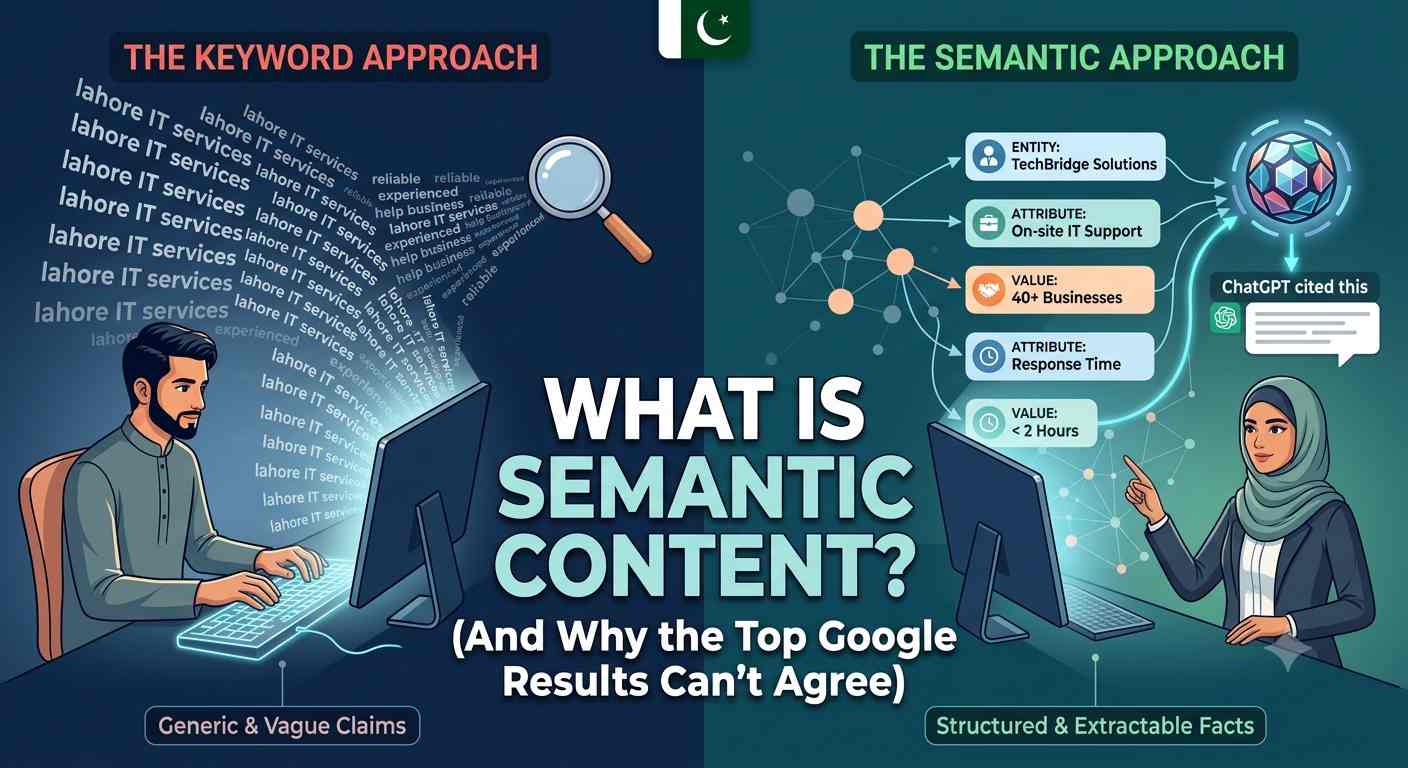
Semantic content is writing about the entire topic and not just one keyword. It responds to the primary question and other related questions. It aids search engines and AI in comprehending the material. It can boost the page's performance in Google and could also be beneficial to your content being utilized in AI answers.
This guide fills that gap. It explains semantic content in easy English. It uses simple, real examples. It works whether you are reading this in Lahore, London, or Los Angeles. It also shows you, step by step, how to write semantic content yourself.
What is Semantic Content? (Simple Definition)
Semantic content focuses on meaning, not just on a keyword.
In old SEO, writers used the same keyword again and again. For example, an article about ‘best running shoes’ might repeat this phrase 20 times. This is called keyword stuffing.
Semantic content works in a different way. It covers the whole topic instead of focusing only on one keyword. For example, it can talk about different shoe types, foot shapes, price ranges, and common mistakes. It uses related words and topics instead of repeating one exact phrase.
In short:
● Keyword content answers one search.
● Semantic content answers one topic, with all its related questions.
Search engines no longer read pages word by word. They try to understand what a page is truly about. This is called semantic search. Semantic content matches how these smart systems now think.
The E-A-V Method: A Simple Formula for Semantic Content
There is one easy formula for semantic content: Entity, Attribute, Value.
● Entity is the exact thing you are talking about. Not "we" or "it." A named person, place, brand, or object.
● Attribute is a specific feature of that entity.
● Value is the exact detail or number for that feature.
Here is a weak sentence with no E-A-V structure:
"Our coffee shop serves great coffee and offers a cosy atmosphere."
This tells a reader nothing real. Now compare it to a sentence built with E-A-V:
"Bean & Bloom, a coffee shop in Manchester, roasts its own beans. It does this every Tuesday and Friday."
The second sentence includes the business name, detail and what the business does. This helps the reader to understand the sentence. When composing your paragraphs, do the same. Name the entity. Provide a single prominent feature. Make up a number or fact. Don't use words that don't have a specific number or fact behind them, such as ‘great' or ‘quality'.

Why Semantic Content Matters in 2026
1. It matches how people actually search
People don’t search in 2026 the way they did in 2010. In the past, they often used short phrases like ‘cheap flights Lahore’. Today, people also use longer queries like ‘cheap way to book flights from Lahore to Dubai.’.
2. It builds trust with readers
When your article covers a topic well, readers can find most of the information they need on your page. They may not need to visit many other websites. Useful content can help build trust with readers, and they may come back later for more information. This can also help your website over time.
3. It powers AI search tools
Google AI Overviews, ChatGPT, and Perplexity aren't simply looking for keywords. They search for explanations on an idea. These tools will be more inclined to quote your article if it's on a topic well covered. This is the whole concept of GEO and AEO, as explained next.
4. It helps build topical authority
Search engines pick up on the fact that many articles are in-depth on a particular topic. They begin to regard your site as an authority on the topic. It's referred to as topical authority. Semantic content is the main building block of it. A superficial article will not do the job. Many long, in-depth pieces will.
Semantic Content vs Keyword-Stuffed Content: A Real Example
Compare two short paragraphs on the same topic: "how to make green tea."
Keyword-stuffed version:
"Green tea is good for health. If you want to make green tea, boil water for green tea. Green tea should be made with fresh water. Green tea tastes better with fresh water."
This sounds robotic. It repeats "green tea" again and again. It gives almost no real value.
Semantic version:
"Green tea has a light, slightly bitter taste. To brew it well, heat water to about 80°C. Do not let it reach a full boil. Boiling water can burn the leaves. This makes the tea taste harsh. Let the leaves sit for two to three minutes. Add a little honey for a milder taste."
This version never repeats "green tea" in an odd way. But it fully answers the question. It adds real details: exact temperature, timing, and taste tips. This is semantic content. It is written for a real human. It also happens to please search engines.

How Search Engines Understand Meaning (Without the Jargon)
Search engines used to match exact words. Today, they try to understand concepts. Google now understands that "car" and "vehicle" often mean the same thing. It also knows "Lahore" connects to "Punjab" and "Pakistani food."
This shift did not happen overnight. Google rolled it out through a few major updates:
● Hummingbird (2013) — Google began reading full queries for meaning.
● RankBrain (2015) — Google used machine learning on new, unusual searches.
● BERT (2019) — Google learned to read a sentence in both directions.
● MUM (2021) — Google could understand text, images, and languages together.
Each update pushed search further away from keyword matching. Each one rewarded content that explains real meaning.
This web of connected ideas is sometimes called a Knowledge Graph. You do not need to memorize any of these update names. Just remember one simple rule:
Write about a topic the way an expert would explain it to a friend. Use natural words, not robotic repeated phrases.
Follow this rule, and your content naturally becomes semantic content.

The Three Layers Behind Every Strong Piece of Semantic Content
Think of semantic content as three layers stacked on top of each other:
1. The meaning layer. This is your E-A-V work: clear entities, clear attributes, clear values, in every paragraph.
2. The structure layer. This is your headings and paragraph order. Each heading should stick to one clear topic, and never jump to an unrelated subject halfway through.
3. The extraction layer. This is how easily one paragraph stands alone. AI tools often quote just one paragraph, not your whole article. Each paragraph must make sense on its own.
Weak content usually skips one of these layers. Strong semantic content builds all three at once.

Semantic Content and GEO (Generative Engine Optimization)
The key to GEO is ensuring that your content is easily discoverable and quote-able by AI tools. That's where tools such as ChatGPT, Gemini, and Perplexity come in. In mid-2026, over 50% of all searches contain AI-generated response. It doesn't just have blue links in a linear list anymore!
AI tools do not "read" your page the old way. They break it into small meaning chunks. Then they pick the chunk that best answers a question. Semantic content helps here because:
● It uses clear, complete sentences that stand well alone.
● It groups related facts under clear subheadings.
● It explains ideas fully, so AI does not need to guess.
Example: Imagine you have two pieces of content that cover the same topic, but have different perspectives. One has a paragraph that contains five ideas. The other has labeled short sections. It features sections such as "What it is" and "Why it matters. It's quite easy to extract a clean answer from the second one using an AI tool. Here is the proof of the concept - GEO in action!.
Semantic Content and AEO (Answer Engine Optimization)
AEO means shaping content so it can be picked as a direct answer. This includes Google's featured snippets. It also includes "People Also Ask" boxes and voice replies.
AEO works best with a simple pattern:
1. State the direct answer in one or two short sentences.
2. Add supporting details right after that short answer.
3. Use clear headings that match real questions people ask.
Notice how this guide follows that exact pattern. Each section opens with a short, clear answer. Then it adds more depth below. This structure works well for human readers. It also works well for AI answer engines.

Schema Markup: The Technical Side of Semantic Content
Most guides on this topic stop at "write naturally." But one small technical piece helps even more: schema markup.
Schema markup is a short code added to your page. It does not change what readers see. It simply labels your content clearly for machines. It can label a section as an "FAQ." It can label a recipe as a "Recipe," with exact steps and times.
Why does this matter for semantic content? It makes the meaning clearer. Without it, a search engine has to guess what a piece of content means. With it, the meaning is clearly stated. This can help both search engines and newer AI tools understand the content.
You do not need coding skills for this. Many free WordPress plugins can add basic schema. FAQ Page schema is a simple option for FAQ sections. It helps search engines understand the questions and answers. But it does not guarantee a featured snippet or an AI citation.
Real Example: Turning a Weak Article into Semantic Content
Say you run a food blog. You wrote this old-style paragraph on "biryani recipe":
"Biryani recipe is a famous dish. Biryani recipe needs rice. Biryani recipe needs chicken or mutton. People love biryani recipe."
This repeats "biryani recipe" in an awkward way. It gives no real value. It will not rank well. No AI tool would ever quote it.
Now here is the same topic, rewritten as semantic content:
"Biryani is a layered rice dish, popular across Pakistan and India. It usually mixes basmati rice with marinated meat and whole spices. These often include cardamom, cinnamon, and cloves. Home cooks debate two main methods. In the 'kacchi' style, raw meat is layered with rice and cooked together. In the 'pakki' style, the meat is cooked first, then layered with rice. Each region adds its own touch. Sindhi biryani uses more tomatoes and chilies. Hyderabadi biryani leans on saffron and yogurt."
See the difference? The second version never repeats "biryani recipe" oddly. But it teaches something real. It names two cooking styles, key spices, and regional differences. This is exactly what search engines and AI tools reward.

How to Write Semantic Content: A Step-by-Step Guide
Step 1: Understand the full search intent
Before writing, ask what the reader truly wants. Someone searching "semantic content" may also want other answers. They may want to know how it differs from SEO content. They may want to know how to write it. Cover all these angles in one article. Do not split them into five thin, separate posts.
Step 2: List related questions and subtopics
Search Google for your main keyword. Check the "People Also Ask" box. Check related searches at the bottom of results. These reveal the exact subtopics to cover.
Step 3: Use natural language, not repeated exact phrases
Do not force your exact keyword into every sentence. Use natural variations instead. For "semantic content," try "meaning-based content" as well.
Step 4: Answer the main question early
Place your clearest, shortest answer near the top. Do this for both the full article and each section. This helps readers and AI answer engines find your point fast. Save deeper detail for later paragraphs.
Step 5: Use clear structure
Break your article into headings and subheadings. Keep paragraphs short. Use bullet points and numbered steps where helpful. This structure makes your page easy to scan.
Step 6: Add strong, specific examples
Vague claims do not build trust. Specific examples do. Do not just write "brew green tea carefully." Explain the exact temperature and timing instead. Do not just write "biryani has many styles." Name the actual styles and regions.
Step 7: Link to related articles on your own site
If you have related articles, link to them. This article on semantic content could link to a post on keyword research. It could also link to a post on content structure. This internal linking builds topical authority over time.
Step 8: Add an FAQ section
A short FAQ section answers common leftover questions directly. This is an easy way to win AEO placements. Your question-answer pairs match how people search. They also match how AI tools phrase their own answers.
How Semantic Content Builds Topical Authority
Topical authority means your site is a trusted expert on one subject. It is not just one lucky page that ranked once.
Here is how semantic content builds this over time:
● Depth over quantity. Ten deep, connected articles beat fifty shallow ones.
● Internal linking. Connect your articles like a web, not isolated islands.
● Consistent terms. Use the same core terms across your content. This helps search engines see the connection between pages.
● Full subtopic coverage. If your main topic is "SEO for beginners," also cover keyword research and on-page SEO. Link them all back to your main topic.
Over months, this pattern sends a clear signal. Google and AI tools start to see your site as a genuine expert source. This beats chasing one keyword at a time.

Common Mistakes to Avoid
● Writing only for keywords, not readers. If a sentence sounds odd to a human, it is not semantic content. This holds true no matter how many keywords it contains.
● Being too vague. General lines like "this is important" add no real value. Always add specific facts, numbers, or examples.
● Ignoring structure. A wall of text with no headings is hard to read. It is hard for readers and hard for AI tools alike.
● Skipping related subtopics. Covering only the main keyword leaves gaps. A competitor's fuller article can fill those gaps instead.
● Copying other articles' structure. If everyone covers a topic the same way, your article blends in. Add your own examples and your own missing pieces.
The 5-Point Test: Is Your Content Actually Semantic?
Before you publish, run every section through this quick test.
1. The Naming Test. Does the paragraph name a real entity, instead of "we," "it," or "our team"? If not, rewrite it.
2. The Strong Verb Test. Does it use a specific verb, like "roasts," "tests," or "measures"? Weak verbs like "provides" or "handles" usually signal a vague sentence.
3. The Standalone Test. Pull the paragraph out of the article completely. Does it still make full sense alone? If it depends on "as we said above," it fails this test.
4. The One-Topic Test. Does every heading in your article stay on the same core topic? Jumping to an unrelated subject breaks reader trust and confuses search engines.
5. The E-A-V Test. Does the paragraph name at least one entity, one attribute, and one real value? If it only contains vague praise, it fails.
Run this test on an old article of yours. Most content fails at least two or three of these points on the first pass. That gap is exactly what you need to fix.
A Quick Checklist Before You Publish
Run through this short checklist before you hit publish.
● Does the article open with a clear, direct answer?
● Have you covered three to five related subtopics?
● Have you used natural word variations, not one repeated phrase?
● Does every section have its own clear heading?
● Have you added one specific, real example with real numbers?
● Have you linked to two or three related articles on your site?
● Have you added an FAQ section with short, direct answers?
● Have you added basic schema markup, such as FAQPage?
● Does your content pass all 5 points of the semantic test above?
Say "yes" to most of these, and your content is ready. It will work well for SEO, AEO, and GEO all at once.
Writing Semantic Content for a Global, Mixed-Fluency Audience
Simple English is useful for readers in every country. People in the UK and US also read quickly, especially on mobile phones. Short sentences and a clear structure make content easier to read for everyone. It is not only helpful for people who speak English as a second language.
If your audience is from South Asia, a few extra things can help. Many people in India and Pakistan search using both English and their local language. This is sometimes called ‘Hinglish’ or ‘Urdish.’ For example, they may search for ‘semantic content kya hota hai’ or ‘semantic content ka matlab."
To write for both South Asian and Western readers at once, keep these points in mind:
● Simple English everywhere. Avoid heavy business jargon. Short, plain sentences travel well across the UK, the US, India, and Pakistan alike.
● Mix your examples. Use universal references, like coffee shops or running shoes. Also use local ones, like biryani or a London bakery. This helps a wider audience relate.
● Voice search patterns. Users everywhere now ask full questions through voice search, often in their own accent. A natural tone matches these queries better than stiff, formal writing.
● Mobile-first reading. Most readers worldwide now browse on phones. Short paragraphs and clear headings matter for every audience, not just one region.
Write this way, and your content becomes genuinely global. It stays easy to read, whether the reader is in Lahore, London, or Los Angeles.

Frequently Asked Questions
What is semantic content in simple words?
Semantic content fully explains a topic and its meaning. It does not just repeat one keyword many times.
How is semantic content different from SEO content?
Older SEO content often focused on keyword repetition. Semantic content covers a full topic naturally. This also happens to improve SEO results.
Does semantic content help with AI search tools like ChatGPT?
Yes. Clear, well-structured content is easier for AI tools to quote. This directly supports both GEO and AEO goals.
Do I need special tools to write semantic content?
No special tools are required. You mainly need deep topic research. List related questions, then write clear, organized answers.
Does semantic content replace keyword research?
No. Keyword research still shows what people search for. Semantic content builds a fuller answer around those keywords.
What is the E-A-V method in semantic content?
E-A-V stands for Entity, Attribute, Value. It means naming a real subject, one clear feature, and one exact detail in each paragraph.
Final Thoughts
Semantic content is not just a short-term trend. It is becoming more important as search engines and AI tools try to understand content better. It helps content that explains a topic clearly and fully. Clear language, real examples, and a simple structure can also make the content easier to understand.
Write about the real questions your readers have. Cover the topic well and keep your article easy to follow. This is the basic idea of semantic content. Do the same for other articles on your website. Over time, this can help your website build better search visibility and authority.
Read more about SEO Instant Appear HighSoftware99.com best Ranking Guide